The Hidden Cost of Lamp Failure in Food Manufacturing
When a lamp fails in a food production environment, replacing it is often the simplest part of the process.
The greater challenge is understanding what the failure means for product safety. If there is any possibility that broken glass has entered the production area, manufacturers must take immediate action to protect product integrity before production can resume.
Depending on where the failure occurs, this may involve stopping production, carrying out thorough inspections, cleaning equipment and confirming that there is no risk of contamination. While these precautions are essential, they can also lead to significant operational disruption.
In food manufacturing, the impact of a lighting failure is rarely measured by the lamp itself. It’s measured by the time spent protecting product, the disruption to production and the confidence that every product leaving the factory remains safe.
Why Lamp Failure Can Disrupt Food Manufacturing
In many production environments, an unexpected lamp failure requires far more than a simple replacement.
Maintenance teams may need to isolate equipment, access difficult-to-reach fittings and investigate the cause of the failure. Depending on the location, quality teams may also need to assess whether production has been affected before operations can continue.
What begins as a routine maintenance task can quickly become a coordinated effort involving engineering, production and quality teams. The objective is always the same: ensuring product safety while returning the production line to normal operation as efficiently as possible.
How Lamp Failure Can Affect Food Safety
Whenever there is a possibility that glass could have entered a production area, manufacturers have a responsibility to investigate thoroughly.
The response will depend on the circumstances, but it may include inspecting equipment, carrying out extensive cleaning procedures and assessing whether any products or batches could have been affected. These steps help protect consumers and maintain confidence in the quality of the finished product.
The operational impact can also be considerable. While investigations are carried out, production may be paused, schedules adjusted and valuable manufacturing time lost. For many businesses, the greatest cost isn’t replacing a lamp – it’s the production that cannot continue until the area has been declared safe.
A Real-World Example from Food Manufacturing
This was highlighted by Arla Foods, who shared an incident where a light fitting failed inside one of their filler cabinets.
The immediate priority wasn’t replacing the lamp. Instead, the production line was taken out of operation while the area underwent an extensive clean and inspection to ensure there was no possibility of glass contamination. According to Arla, the incident resulted in around 12 hours of downtime and an estimated production loss of £12,000–£14,000.
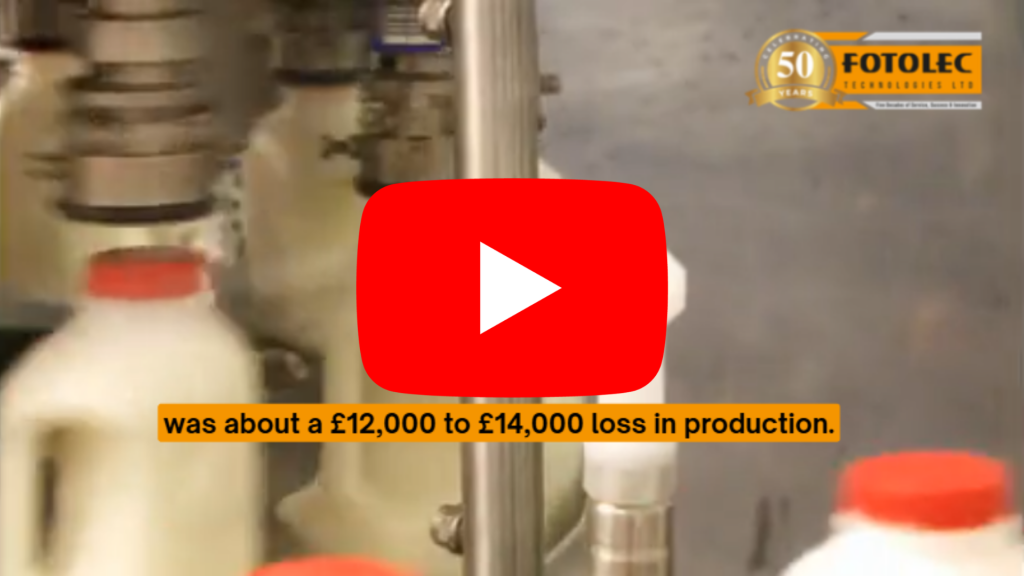
This is a powerful reminder that the consequences of a lighting failure extend far beyond maintenance. Protecting product integrity must always come first, and even a single incident can have a significant operational impact.
Why Shatterproof Lamps Help Reduce Contamination Risk
No lamp is immune to accidental damage or eventual failure. The aim is not to eliminate every possibility of failure, but to reduce the risks and consequences should the unexpected occur.
This is why shatterproof-coated lamps have become an important part of food manufacturing environments. Rather than preventing a lamp from failing, the protective coating is designed to help retain broken glass if the lamp is damaged or breaks. By helping to contain glass fragments, shatterproof coatings support foreign body control procedures and can simplify the clean-up process following an incident.
Used alongside preventative maintenance, appropriate lighting specifications and robust quality systems, shatterproof-coated lamps form part of a wider strategy for reducing contamination risks within food production facilities.
Why Reliable Lighting Supports Food Safety and Operational Continuity
Every component within a food production environment plays a role in supporting safe, efficient operations, and lighting is no exception.
Selecting reliable lighting solutions that are appropriate for the application helps manufacturers reduce unnecessary disruption while strengthening their wider food safety strategy. Although no single measure can remove every risk, thoughtful product selection and preventative maintenance can significantly reduce the likelihood and impact of unexpected incidents.
For more than 50 years, Fotolec has supported food manufacturers with lighting solutions designed for hygiene-critical environments. Our shatterproof-coated lamps are developed to help businesses reduce contamination risks, protect product integrity and support operational continuity, giving manufacturers greater confidence should the unexpected occur.